Ocala Horse Farm Buyers Guide: Features to Review
If you are shopping for an Ocala horse farm, acreage alone will not tell you enough. In Marion County, where equine use shapes both the landscape and daily life, the right property needs to support your horses, your schedule, and your long-term plans. A beautiful entrance or big parcel can be appealing, but the real value often comes down to layout, drainage, access, and flexibility. Let’s look at the key property features that deserve a close evaluation before you buy.
Ocala sits in the center of one of the most established equestrian regions in the country. Marion County identifies the area as the Horse Capital of the World® and says the county has more horses and ponies than any other county in the United States, with more than 195,000 acres in equine use.
That local depth matters because you are not just buying land. You are buying into an equestrian ecosystem supported by veterinarians, feed and tack retailers, blacksmiths, equine dentists, and transportation companies. In practical terms, a horse farm in Ocala should be evaluated by how well the site and improvements fit your horse program, not by size alone.
Marion County’s long-term planning also places importance on protecting rural, equestrian, and agricultural areas. That makes it especially important to understand how a property functions today and how it may fit your future goals.
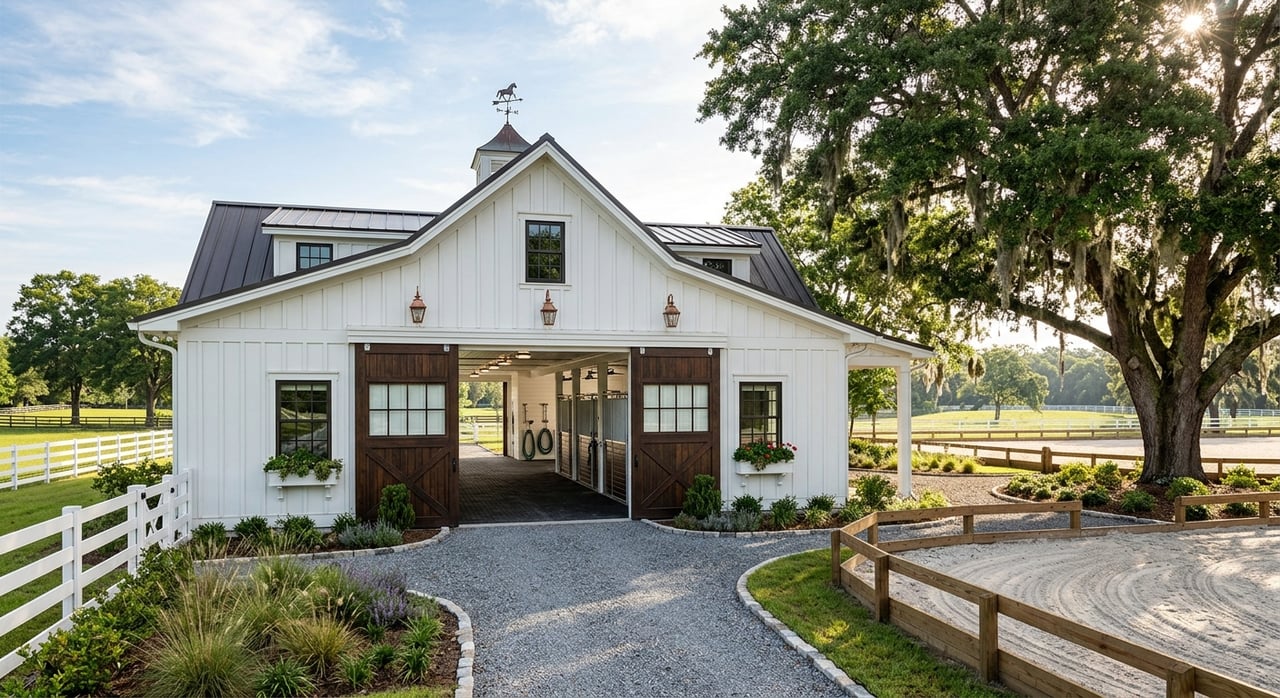
A barn can look impressive at first glance and still create friction every day. UF/IFAS guidance says a horse barn should protect horses from weather extremes, stay free from drafts, provide fresh air, give horses a dry place to bed down, and reduce injury risk.
When you tour a property, think beyond stall count. Ask yourself whether the barn supports your actual routine, including feeding, turnout, grooming, tacking, and recovery. A layout that saves steps and limits cross-traffic can make a major difference over time.
A well-planned barn should have logical spaces for:
UF/IFAS also notes that barns should allow enough space for both horses and caretakers. That means aisle width, access to water, and room to move equipment all deserve attention.
One common mistake is assuming a large-looking barn will automatically work well. UF/IFAS cautions that exterior dimensions can hide lost interior space, which means the footprint may feel less efficient once you are inside.
Single-story, clear-span construction can offer advantages when safety, ventilation, and flexibility matter. If you may expand later, ask whether the current layout could absorb another wing, added storage, or changes in use without disrupting the entire operation.
The areas around the barn are just as important as the barn itself. Trailer circulation, manure handling, hose access, turnout gates, and the ability to separate breeding, training, or recovery uses can all affect how smoothly the farm runs.
On a showing, try to picture a normal week on the property. If you can already see bottlenecks, awkward turns, or limited service access, those issues will likely feel bigger after closing.
In Ocala, good pasture is not simply green pasture. UF/IFAS says Florida’s climate supports forage production through much of the year, but success depends on soil drainage, site characteristics, forage selection, liming and fertilization, and grazing management.
This is why high, well-drained acreage often offers more day-to-day value than land that stays wet or boggy. A farm may have plenty of acres on paper, but if a meaningful portion of it is hard to use, your flexibility drops quickly.
UF/IFAS provides a useful rule of thumb. A mature horse may need about 1 to 1.5 acres on productive, well-managed summer pasture, or about 2 to 2.5 acres on less productive sites.
That does not mean every farm should be judged by a single formula. It does mean you should compare the usable pasture footprint to your horse count, grazing goals, and management style.
A property with a strong paddock layout may outperform a larger farm with poor subdivision. Multiple turnout areas can support rotational grazing, rest cycles, and more controlled daily use.
If stocking becomes too dense, UF/IFAS notes that pasture may stop functioning as a primary feed source and shift into more of an exercise area. That is why it helps to evaluate not only how much land exists, but how the land is divided and managed.
UF/IFAS says different forages fit different drainage conditions. Bahiagrass tolerates heavier grazing and a wider range of site conditions, while bermudagrass and small grains generally need better drainage and more management.
For you as a buyer, the key question is whether the land suits the way you plan to use it. Some buyers want strong grazing pasture, some prioritize turnout, and some rely more on dry-lot management with limited forage use. The best property is the one that aligns with your actual program.
For many equestrian buyers, location is about more than privacy or scenery. It is also about haul-in time, road access, and convenience to the venues you use most.
Ocala’s event infrastructure is a major part of its appeal. World Equestrian Center – Ocala includes 29 indoor and outdoor arenas, nearly 3,000 stalls in 25 barns, wash racks, tack rooms, and facilities that support multiple disciplines. Florida Horse Park is another major venue, with a 500-acre multipurpose campus, permanent stalls, a covered arena, dressage arenas, and extensive cross-country features.
These venues are not in the same part of Marion County. World Equestrian Center – Ocala is in northwest Ocala, while Florida Horse Park is in south Marion County.
That means drive time should be evaluated property by property. Before you buy, map the route to the venue you expect to use most and consider trailer access, road quality, and likely traffic patterns.
Marion County says the area’s equine industry is supported by a wide network of veterinarians, feed and tack retailers, blacksmiths, equine dentists, and transportation companies. A farm that sits closer to the specialists your operation uses most can save time and reduce disruption.
This kind of convenience may not show up in listing photos, but it can shape your ownership experience in a meaningful way. In a market as active as Ocala, service access is part of the property’s practical value.
The right horse farm should fit your needs now, but it should also leave room for what comes next. You may eventually want another barn, more turnout, a larger ring, or added utility capacity.
That is why expansion potential should be part of your initial screening process. A property that works today but limits growth can become expensive to adapt later.
As you evaluate a farm, ask:
Marion County’s comprehensive plan supports preserving rural character and agricultural uses, while also limiting central water and sewer extension outside the Urban Growth Boundary and Planned Service Areas. That makes early utility review especially important when you are considering growth.
One of the most important parts of horse-farm due diligence happens before closing. Marion County says bona fide agricultural nonresidential farm buildings, fences, and signs are exempt from the Florida Building Code and county or municipal code or fee, except for floodplain regulations.
At the same time, the county also notes that most construction, enlargement, alteration, repair, and system work still requires a permit unless an exemption applies. In other words, buyers should not assume every barn, arena, or future improvement is automatically exempt.
Before closing, it is wise to verify:
Marion County also says agricultural land classification applications must be filed on or before March 1 each year. While each purchase is different, this timeline is an important detail to keep in mind as you plan ownership.
When you walk a potential horse farm in Ocala, it helps to focus on a short list of practical questions. These are often more revealing than cosmetic upgrades.
A thoughtful purchase in Ocala is about fit, not just finish. When the land, barn, and location all work together, you set yourself up for a smoother ownership experience from the start.
If you are considering an equine purchase in Ocala, White Horse Group offers a discreet, tailored approach for buyers who want expert guidance on horse property function, lifestyle fit, and long-term value.


White Horse Group is a boutique real estate and design collective delivering luxury service, local expertise, and elevated style to every home and client we serve.
WHITE HORSE GROUP
ADDRESS
1795 9TH ST N
NAPLES, FL 34102